I hear it in first meetings with factory owners across Taiwan. So many of these bosses, the laobans, say at the beginning: “We don’t need to be that well-known, because everybody knows us, or people in the industry know us.” That is a very common mindset.
Many SMEs in Taiwan adopt that same mentality, because that process worked for many years in the past. A parts maker sells to the same few customers for decades; everybody who matters already sits across the table, and being known costs nothing. The laoban who says he doesn’t need a brand is describing his world accurately.
That world is changing. Commercial Times reported on 26 April 2026 that Taiwanese auto parts makers are moving into AI server cooling and semiconductor equipment. United Alloy-Tech (精確, Taipei Exchange: 3162) began small-volume production of AI server water-cooling products at the end of 2025, and its immersion cooling tanks and manifolds already bring in tens of millions of NT dollars a month. At Sixxon Tech (六方科-KY, 4569), shipments of quick-disconnect connectors for AI server cooling are driving growth, and its March and first-quarter revenue were both records.
There is a catch. These companies are well known in the car industry; in the data center business they have little history. Does a name built in one business mean anything in the next?
Why referrals don’t carry into a new business
You have to have a brand so you can break into new businesses as they gain steam and opportunities arise. Decades of research by Byron Sharp, Jenni Romaniuk and their Ehrenberg-Bass Institute colleagues explain why: brands grow mainly by adding buyers, mostly light and occasional ones, by being easy to recall when a buying situation comes up and easy to buy from.
Most Taiwanese manufacturers grow through old customers and referrals. That works in the old business. In the new one it falls short, because referrals travel inside the circle of people who already buy from you, and the new buyers sit outside it.
Buyers think in situations, Romaniuk’s “category entry points,” before they think in supplier categories: a plant manager thinks “the line keeps stopping” before he thinks “automation integrator.”
In 2020 I worked with a chain manufacturer, well known for bicycle chains, that was building its own motorcycle chain brand. Heavy motorcycle chains are mainly sold and fitted by repair shops, when an old chain wears out. In our rider survey, six in ten riders followed the shop’s advice. A brand the shop has never heard of rarely gets fitted.
What survives a rebrand
In July 2020 interviews at that client, one of its e-commerce and brand marketing staff summed up its brand history. From our interviewer’s notes: past projects were like fireworks thrown into a pit before they went off.
Some of those fireworks were mine. In a 2014 project, my firm gave the company a positioning, a set of values, a dealer guide and a staff workshop. There was no rollout budget; five weeks after the workshop the branding work went on hold. The values later headed one page of its 2017 catalog; the English brand statement and the slogan are gone today.
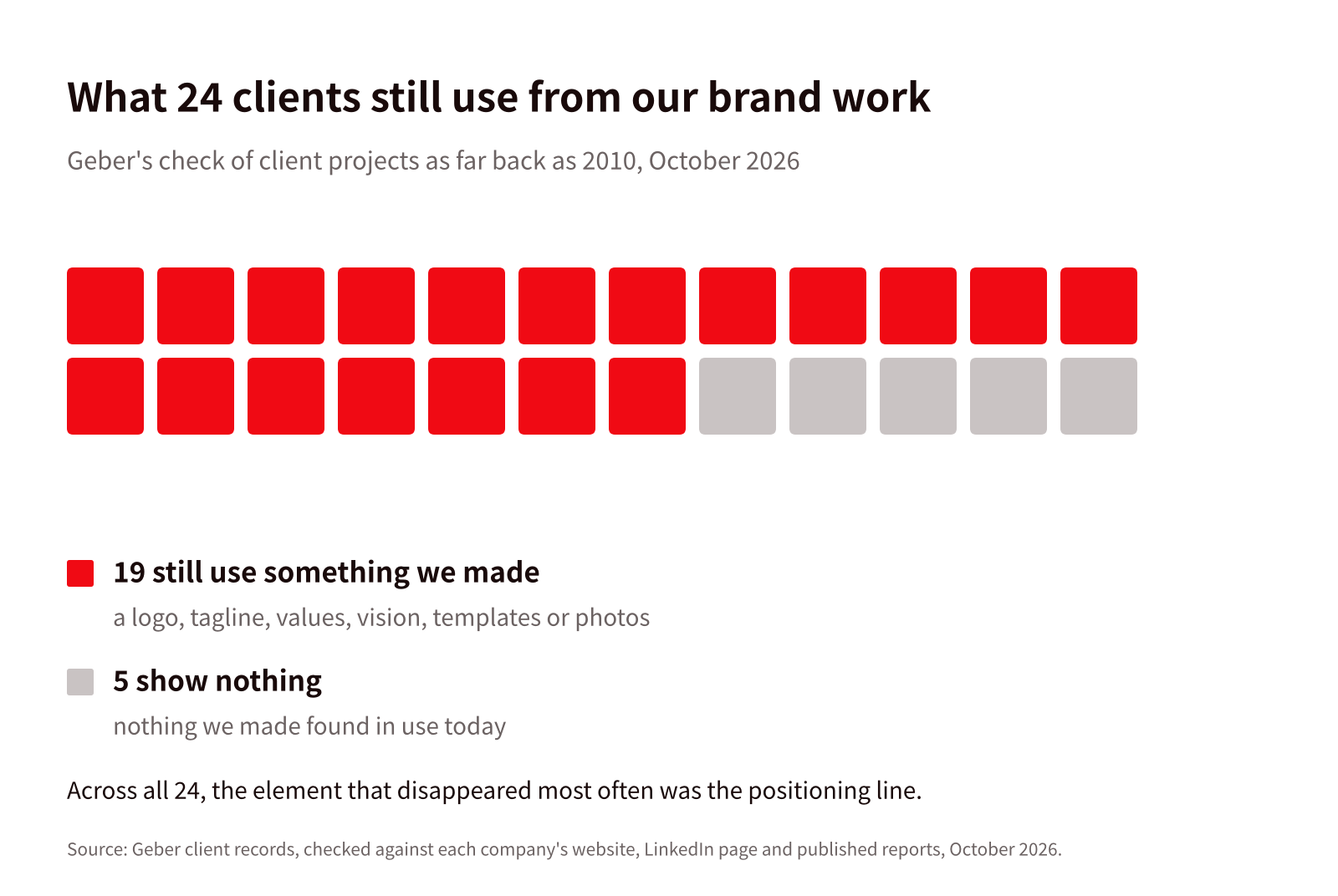
In October 2026 my team checked our brand work for 24 Taiwanese clients, going back to 2010, against what each uses today. Nineteen still use something we made: a logo, tagline, values, vision, templates or photos. Five show nothing, three of them ending with the strategy and no paid rollout. The positioning line disappeared most often. What survived sits mostly on About pages and LinkedIn headlines, and in sustainability reports and investor presentations.
One thermal materials company calls the tagline from our 2019 rebrand its mission in the CEO’s letter of its 2024 sustainability report, and the positioning appears almost word for word in that report and the 2023 one. A green energy retailer chose one of four taglines we proposed in 2023. The chairman’s message in its 2025 sustainability report names it as the company’s core value, and it is the title of the company’s May 2026 investor presentation.
The difference is housekeeping. Each of those places gets updated from the previous version, so the words are carried forward. A line that lives only in a strategy report belongs to nobody, and nobody reprints it.
Brand as a monthly deposit plan
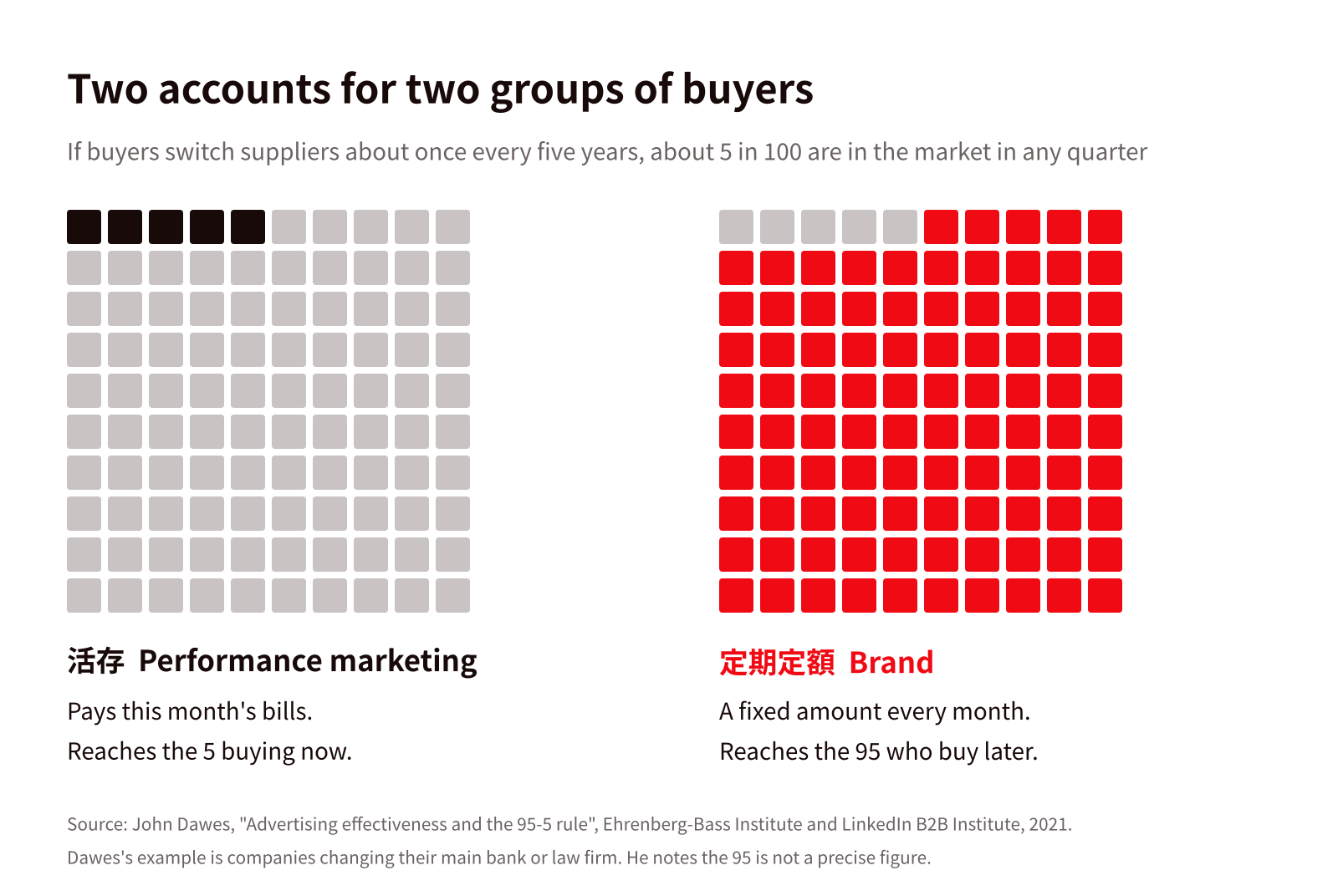
Brand works like what Taiwanese investors call 定期定額, a monthly investment plan: a fixed amount goes into a fund every month, whether the market is up or down. It grows because you leave it alone. Performance marketing is the demand deposit account (活存) that pays this month’s bills. A company needs both.
How many buyers can hear you this month? Professor John Dawes of the Ehrenberg-Bass Institute, in a 2021 paper published with LinkedIn’s B2B Institute, put a number on it: up to 95 percent of business buyers are not in the market at any given time. In his example, companies change their main bank or law firm about every five years, so roughly 20 percent buy in a year and 5 percent in a quarter. Dawes says the 95 is not meant as a precise figure; for machinery replaced every ten years, the share buying right now is smaller still. Trade shows and sales visits mostly reach that 5 percent. The other 95 will buy later, from whoever they remember.
What to do when you move into AI supply chains
For a manufacturer moving into AI supply chains, the work is concrete. First, decide which buying situations your name must be remembered in: a cooling supplier chosen in a hurry, or a connector that cannot leak. Then put those words where they keep getting repeated. In a new business, that means the documents the new buyers actually see: the website and the datasheets, alongside the annual reports. And pay for them like a monthly deposit plan, a fixed amount every month, in good quarters and bad.
More AI data centers will be planned and their cooling budgets approved. The buyers will reach for the names they already know. The companies that start their deposits now will be those names.
If you’d like to hear more about what we do at Geber, we have a regular newsletter: https://www.geberconsulting.com/newsletter/
FAQ
Why doesn’t a manufacturer’s reputation carry into a new industry?
The reputation lives with the customers who already buy from you. Referrals travel inside that circle, and the buyers in a new industry sit outside it. When a buying situation comes up, they reach for the suppliers they already recognize.
How much of a brand project is still in use years later?
In October 2026, Geber checked its brand work for 24 Taiwanese clients, going back to 2010. Nineteen still use something from it, such as a logo, tagline, values or templates. Five show nothing, and three of those ended with the strategy and no paid rollout. What survives sits in documents that get updated from the previous version: About pages, LinkedIn headlines, sustainability reports and investor presentations.
What is the 95-5 rule in B2B marketing?
In a 2021 paper published with LinkedIn’s B2B Institute, John Dawes of the Ehrenberg-Bass Institute estimated that up to 95 percent of business buyers are not in the market at any given time. Trade shows and sales visits mostly reach the 5 percent buying now. The other 95 percent buy later, from the names they remember.
Further reading
- Taiwan’s Auto Parts Makers Are Moving Into AI Liquid Cooling. Being Distinguishable Comes Next. (Geber Insights, November 2026)
- Brand Guidelines for B2B Manufacturers: What a VI Manual Should Include (Geber Insights)
- When Should a Manufacturer Rebrand? Five Triggers, and When to Keep the Logo (Geber Insights)
- Taiwan makes the world’s industrial PCs. AI knows one of them well. (Geber Research, October 2026)
Sources
- Commercial Times (工商時報), 陳慜蔚, “汽零廠跨足AI與半導體!精確、六方科營收創歷史新高 水冷產品出貨引爆,” 26 April 2026: https://www.ctee.com.tw/news/20260426700037-439901
- John Dawes, “Advertising effectiveness and the 95-5 rule: most B2B buyers are not in the market right now,” Ehrenberg-Bass Institute with the LinkedIn B2B Institute, 2021: https://marketingscience.info/news-and-insights/advertising-effectiveness-and-the-95-5-rule-most-b2b-buyers-are-not-in-the-market-right-now
- Geber client records, checked against each company’s website, LinkedIn page and published reports, October 2026.
About the author. Richard deVries is the founder and CEO of Geber, a brand strategy and AI consultancy for B2B manufacturers, based in Taipei with offices in Tampa and Toronto. A Canadian who has lived in Taiwan for more than 25 years, he has spent over 20 years working with Taiwanese manufacturers and hidden champions on strategy and how they go to market. He hosts a monthly AI Roundtable for business leaders and writes about AI and Taiwanese industry for CommonWealth Magazine.
Richard deVries Founder & CEO, Geber Consulting
Grow Beyond Brands
If you’re curious about how brand consultants work and want to find an opportunity to properly examine your enterprise and brand, we’d love to chat over coffee.