Geber Research · Geber Radar: Industrial Memory and Storage, Q4 2026 · 閱讀中文版
Ask an AI assistant which industrial SSD or memory suppliers to shortlist, and three Taiwanese companies each come up in more than half of the answers: ATP, Innodisk and Apacer. The assistants know Taiwan’s storage makers. Yet what they say about them is mostly a product list, and that costs Taiwan the buyers with the strictest requirements.
In October 2026, Geber Research asked ChatGPT, Gemini, Perplexity and Claude 17 questions that overseas buyers of industrial memory and storage ask, five times each, and we read all 340 answers (the method is at the end).
The findings in brief:
- 95% of the answers name a Taiwanese brand, and once AI names a Taiwanese maker it recommends it more often than the US ones.
- On the question a US federal buyer would ask, US suppliers take 64% of AI’s recommendations and Taiwanese makers 23%, even though products made in Taiwan can qualify.
- On FIPS 140-3 security validation, AI recommends one small Taiwanese specialist in all 20 answers and three large Taiwanese makers in none.
- AI gives the buyer a reason beyond the product in 47% of its mentions of Taiwanese makers. For US makers the figure is 62%.
Forrester reported in January 2026 that 94% of business buyers now use AI at some point in their buying process. Engineers are more cautious: in a 2025 survey of more than 1,000 engineers by TREW Marketing and GlobalSpec, 70% said they rarely or never use AI to evaluate vendors. So AI puts together the first list, and engineers verify that list on their own.
1. AI knows Taiwan’s storage makers and rates them well
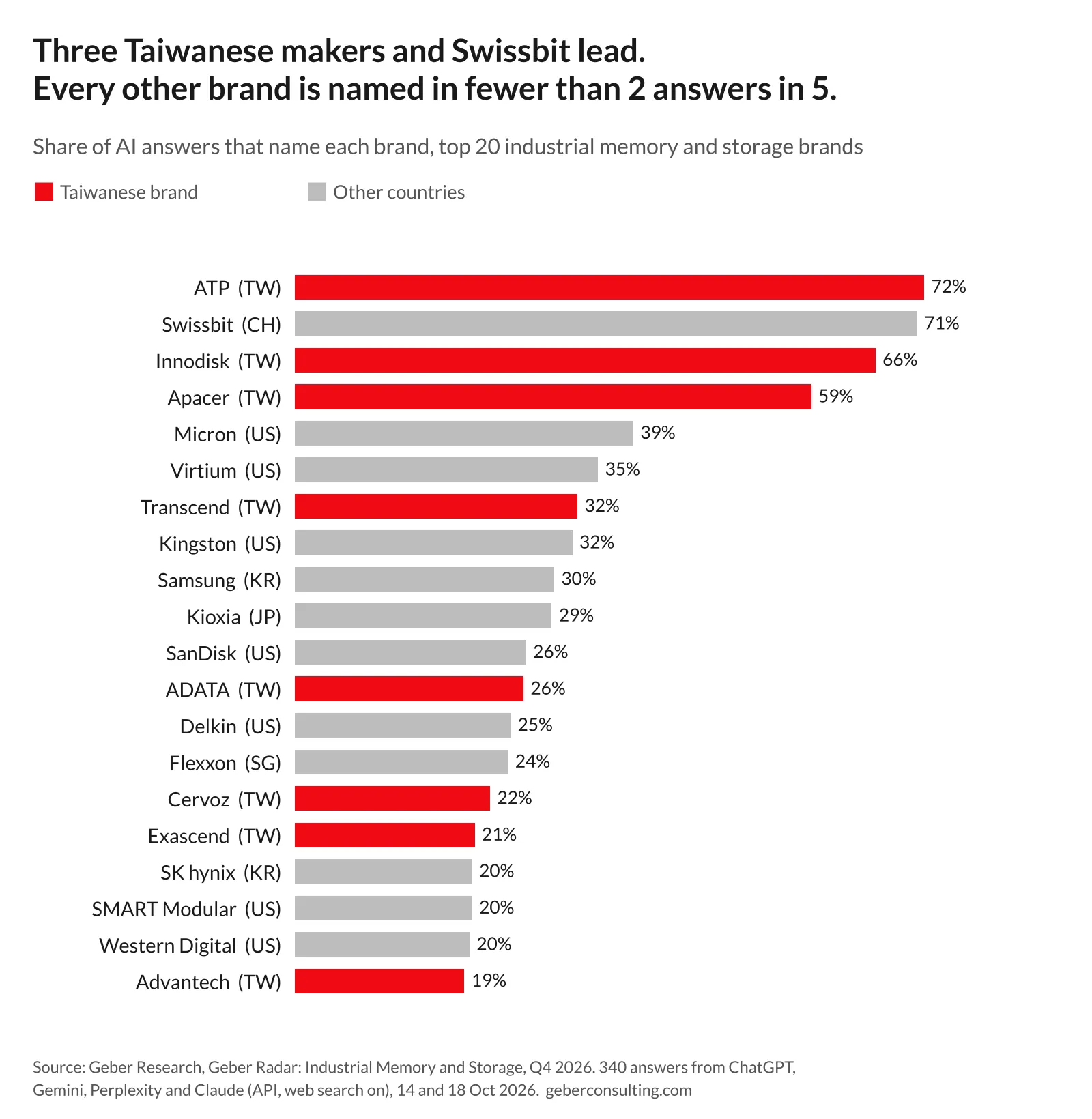
ATP comes up in 72% of the answers, Innodisk in 66% and Apacer in 59%. Swissbit of Switzerland, at 71%, is the only other company in that range. Taiwanese companies account for 43.7% of all brand mentions, ahead of US companies at 30.7%.
Nor do the assistants just mention them. Once a Taiwanese maker is named, AI recommends it 38% of the time; for US makers the rate is 33%.
Across most of the sectors we work in, I see the reverse: a product people respect and a name few overseas buyers recognize. Last month’s industrial PC report found that for most Taiwanese makers. Taiwan’s storage makers have already won that first fight. The rest of this article covers the next one.
2. A federal buyer asks, and AI points to a small US seller
Picture a company that sells equipment into a US federal agency. Any storage built into that equipment must meet the US Trade Agreements Act (TAA), and this buyer also rules out chips from the Chinese makers YMTC and CXMT. On paper, Taiwan sits well. Because Taiwan is a party to the WTO Government Procurement Agreement, products made in Taiwan can qualify under the TAA. On top of that, a 2022 law stops federal agencies, starting 23 December 2027, from purchasing electronic products built with chips from the companies it names, and YMTC and CXMT are on that list.
That buyer’s question went to all four assistants. The recommendations broke 64% to US suppliers and 23% to Taiwanese makers. Micron ranks first. Right behind it sits Bull Creek Technologies, a US seller of TAA-compliant memory that most storage engineers have never heard of. Bull Creek earns a recommendation in 9 of the 20 answers, ATP in 7 and Innodisk in 6.
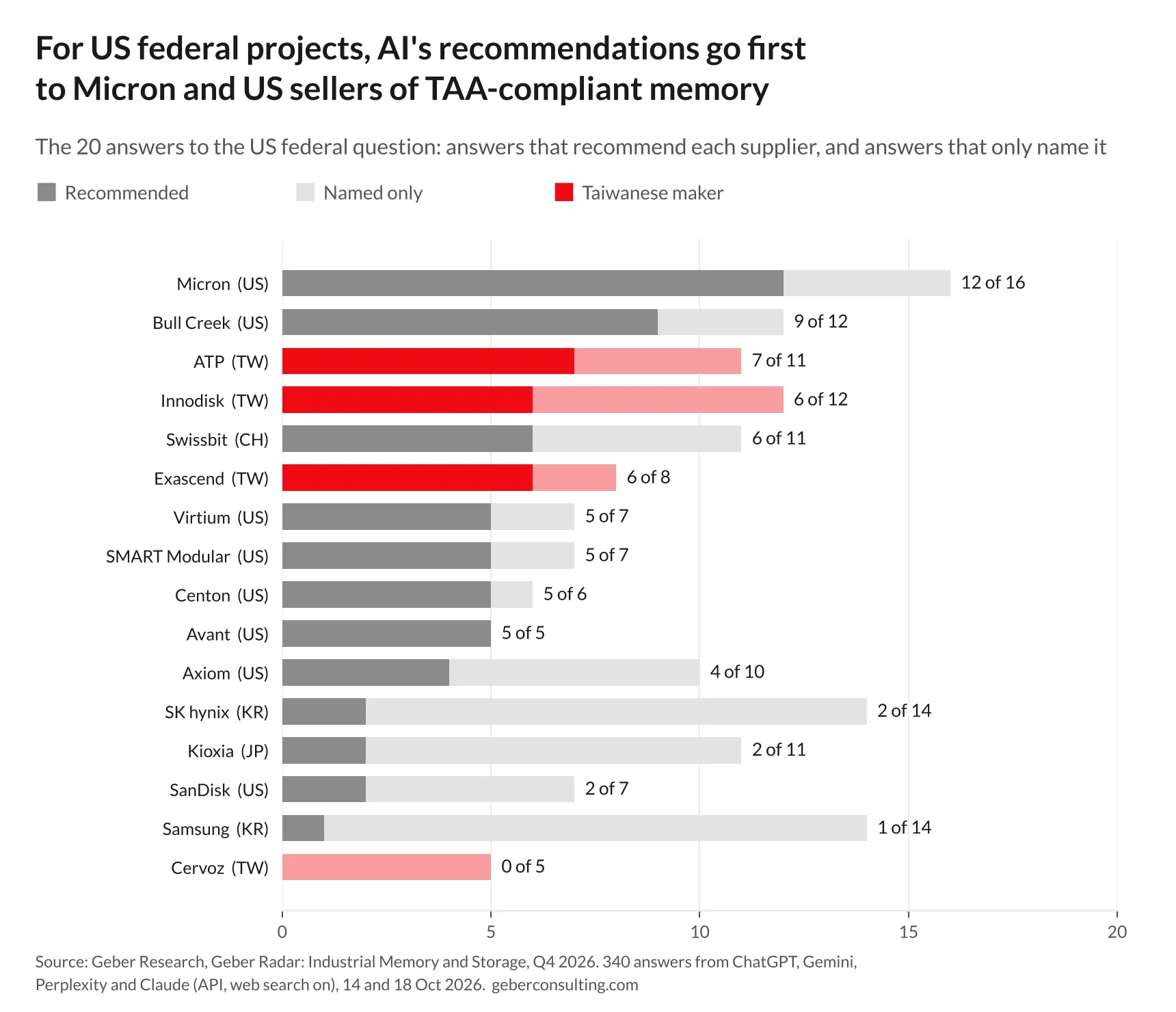
The answers reveal their sources, so we can see what the assistants read. Every one of the 9 answers recommending Bull Creek points to its own website, and 6 of those point to its page on NDAA rules or its compliance page. Among Taiwanese makers we found one with a page on the subject: Exascend, whose TAA page states where each part of its drives is made. That page is cited in 8 of the 20 answers, and Exascend is recommended in 6 of the 8 answers that name it. When we searched the ATP, Innodisk and Apacer websites, no TAA page turned up.
Back in 2022, managers at a Taiwanese fiber optic supplier told us that US rules shutting out Chinese suppliers had made “Made in Taiwan” more attractive to their government and military customers. The same advantage sits with storage makers. What the AI answers reveal is how little of it gets through to a buyer encountering them for the first time.
3. One small Taiwanese specialist owns its question
Taiwan gains from the same effect whenever a Taiwanese company has claimed the requirement for itself.
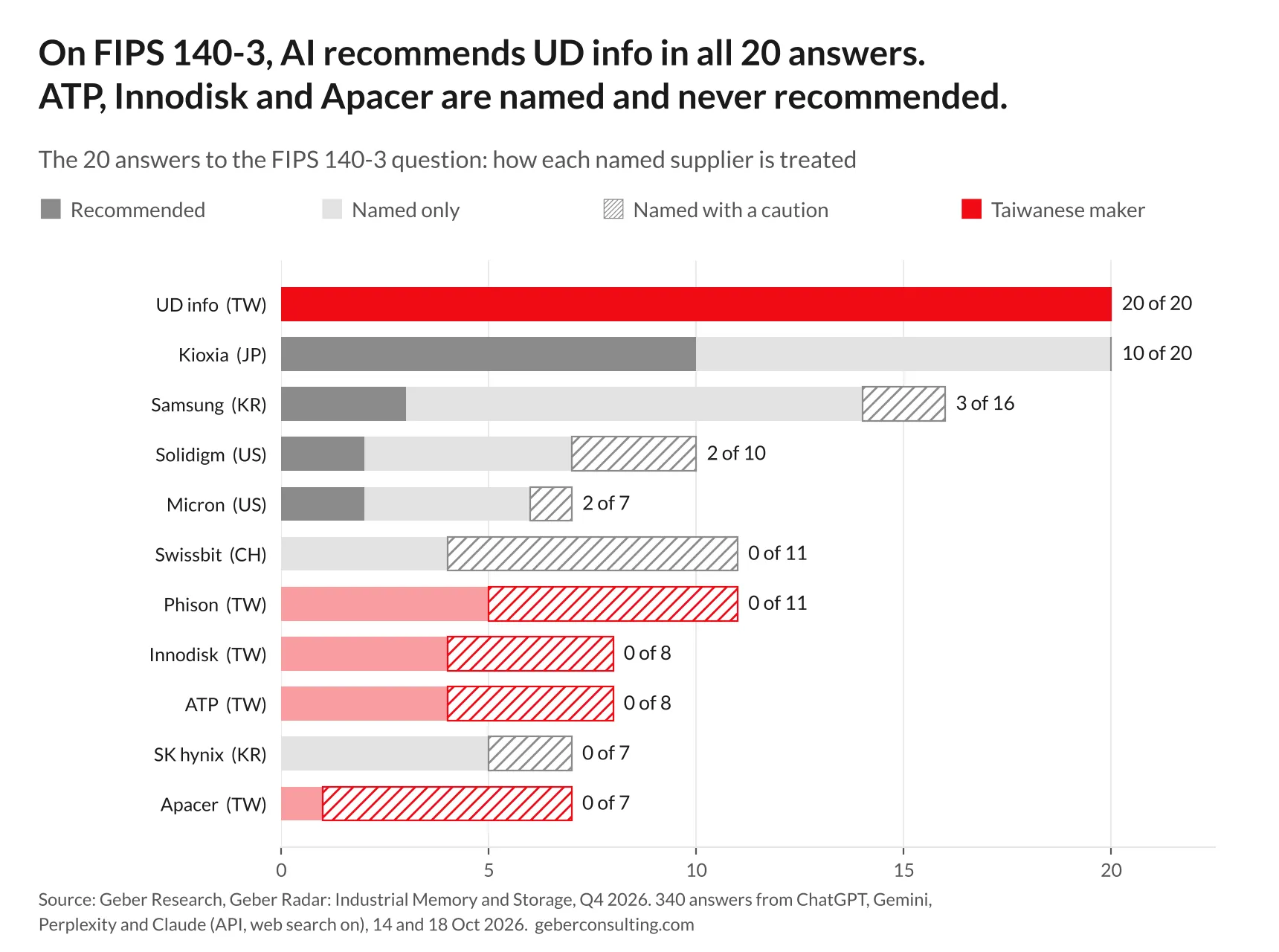
Our question was which manufacturers sell industrial SSDs carrying FIPS 140-3 validation, the US government standard for encryption modules. Every one of the 20 answers recommends UD info. ATP and Innodisk are each named in 8 answers and Apacer in 7, yet none of the three gets a single recommendation. A caution such as “validation not confirmed” comes with most of those mentions.
On this point AI is correct. Our search of the US government’s certificate database on 18 October 2026 turned up no active FIPS certificate under the names ATP, Innodisk or Apacer. UD info, by contrast, was first FIPS validated in 2021 and was granted its FIPS 140-3 certificate in August 2026.
No web page could have produced this result on its own. The larger makers would have to hold the certificate first. UD info earned it and then made it public: its news release on the certificate is one of the pages AI cites.
UD info is a small company, named in just 33 of the 340 answers overall. Yet on the single requirement it has made its own, it beats every larger maker, including Apacer, its parent company since 2022.
4. AI describes Taiwan’s makers by their products
Those two questions sit inside a broader pattern in how AI talks about these companies.
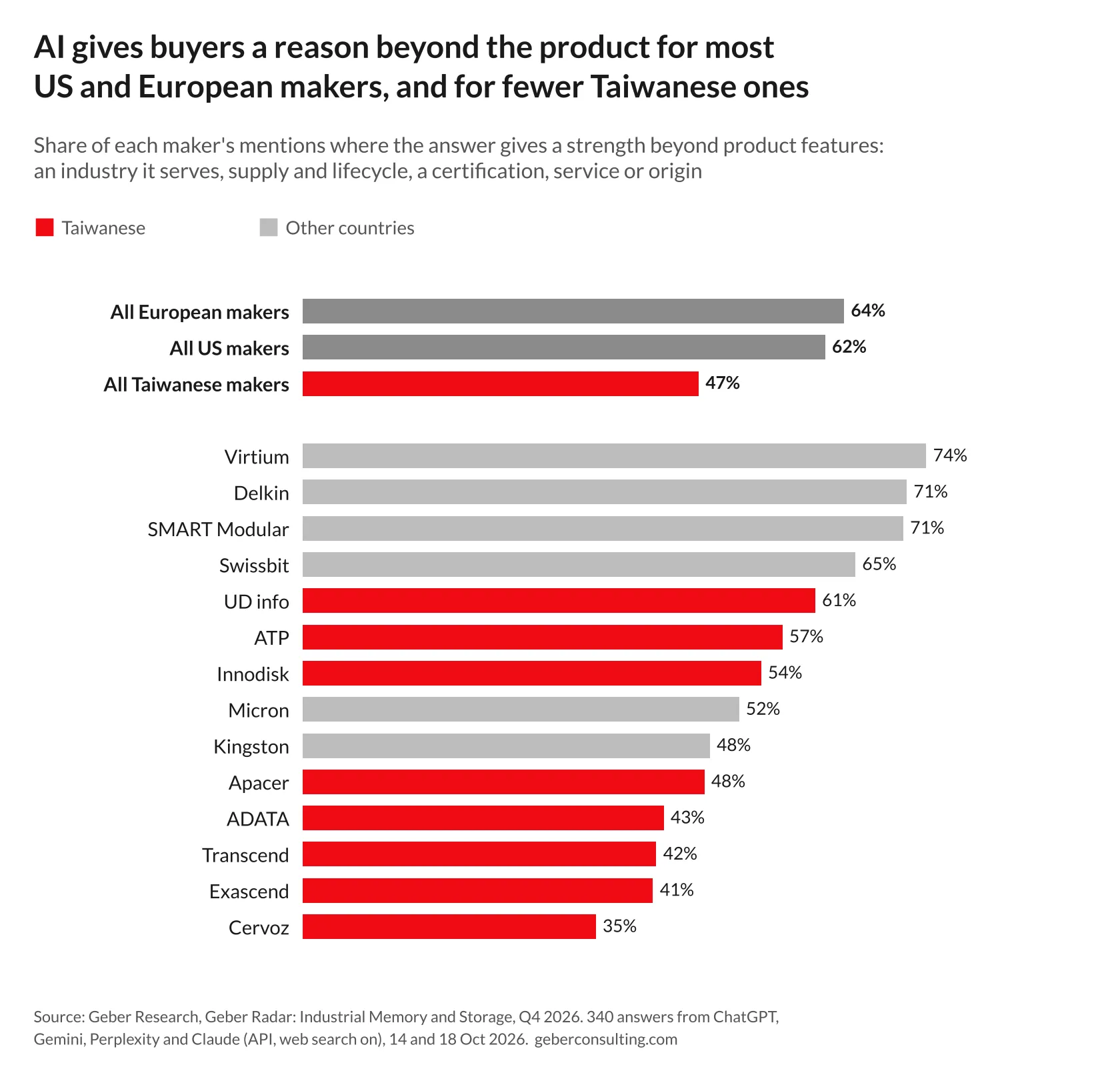
We had two AI models read every answer and judge how it describes each supplier. An answer can describe a supplier only through its products and their features. Or it can also give the buyer a strength beyond the product: an industry the company serves, a supply commitment, a certification it holds, its service, or where it is made.
A strength beyond the product appears in 47% of AI’s mentions of Taiwanese makers, against 62% for US makers and 64% for European ones. Each rival carries an association. Virtium is linked to long-term supply in 53% of its mentions, and SMART Modular to an industry, mostly defense, in 68%. Swissbit is linked to supply in 43% of mentions and to its European origin in 19%. Among Taiwanese makers, supply comes up in 21% of mentions and an industry in 22%.
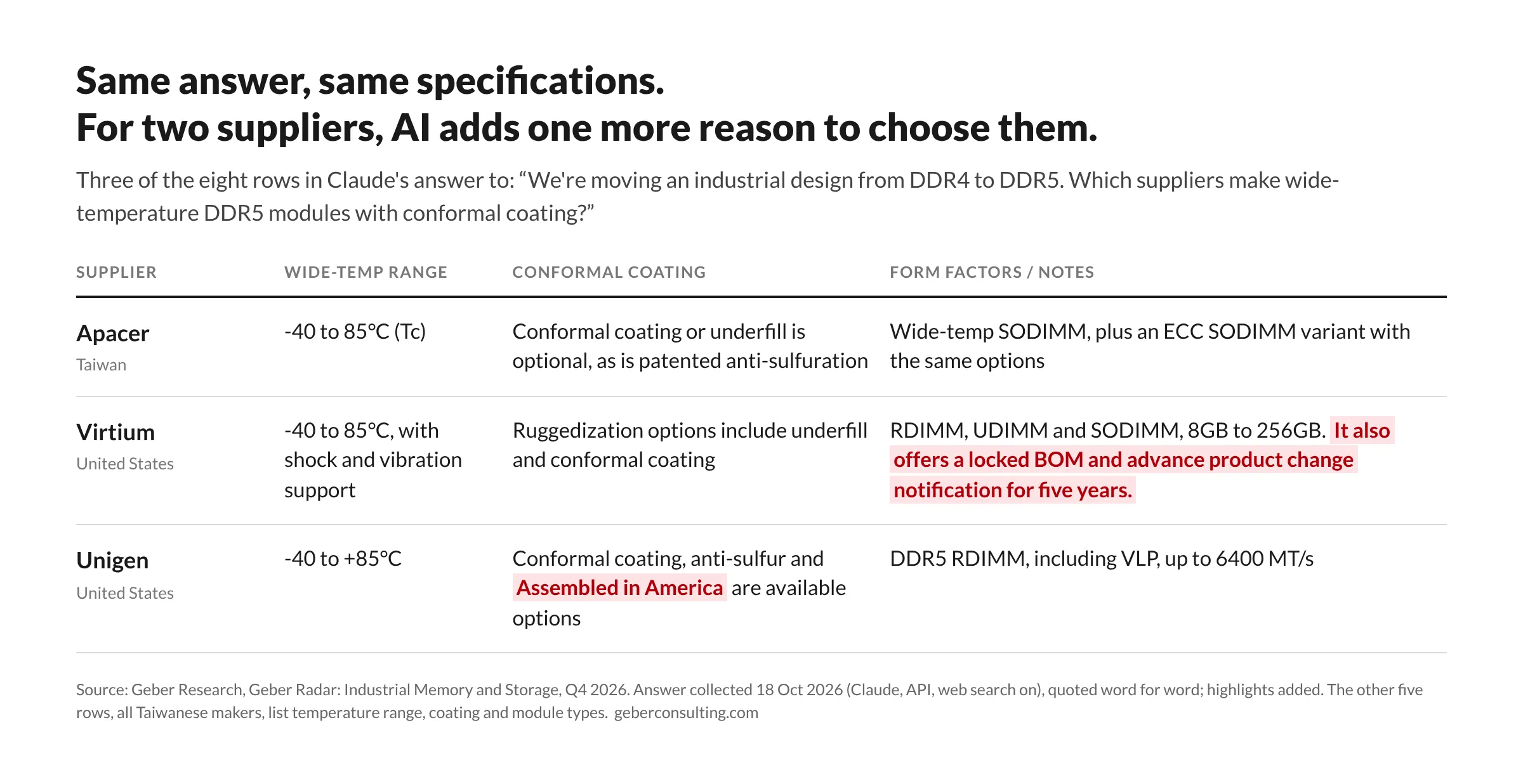
A single answer shows what this looks like in practice. A buyer asks which suppliers make wide-temperature DDR5 modules with conformal coating, a question where Taiwanese makers take most of the mentions. Claude answers with a table of 8 suppliers. For the 6 Taiwanese makers in it, the table gives the temperature range, the coating options and the module types. For the 2 US makers it gives the same details and then goes further. Virtium “also offers a locked BOM and advance product change notification for five years”. Unigen has “Assembled in America” among its options. Every row is accurate. Two of them give a buyer who has just lived through a DDR4 end-of-life notice something more to choose on.
The recommendations show it too. Of the 28 brands named in at least 30 answers, the ones AI connects to something beyond the product are also the ones it recommends more often. Take the well-known Taiwanese names. Transcend appears in 110 answers and is recommended in 24 of them (22%). ADATA appears in 89 and is recommended in 42 (47%). AI talks about the two in much the same terms, so the description cannot account for the gap. The difference lies in what AI reads. ADATA’s explainer pages are cited in 19 answers, and AI recommends ADATA in 16 of the 19 mentions where one of them is cited. Transcend’s explainer pages are cited in 3 answers. These are patterns we observed, and the full report shows each measure for every maker.
What I see in these numbers
I have spent more than 20 years working with Taiwanese B2B manufacturers, and I open every first meeting with the same question: what do you want to be known for? The answer I usually get is a list of product features. When I press further, the owner says the company is already positioned and that people in the industry know it. I reply with two questions. Is that position still the right one for where you want to grow? And does it come through in what the company says and does, so that someone who has never met you would describe you the same way?
That someone now exists, and it is AI. It has gone through your website, your distributors’ pages and everything written about you, and for most Taiwanese storage makers it talks in specifications. Specifications are table stakes, and any competitor can match them. When a federal buyer has to keep Chinese chips out, AI puts forward the company that has claimed that requirement.
A company can fix a web page on its own. Deciding what to stand for is harder from inside, because every department has its own answer and nobody inside hears the company the way a customer does. That decision belongs to the Laoban, the owner and boss of a Taiwanese company, and it is the work we do with our clients.
DIGITIMES, the technology publisher most readers of this article follow, made a decision of this kind. After 28 years as a media brand, it announced in July 2026 that it would stand as a decision intelligence platform, under the line “Define Clarity”. We worked with DIGITIMES on that rebrand, and much of the work was workshops in which its teams agreed how to say it and what it meant for their own work.
What Taiwanese storage makers can do now
- Decide what you want to be chosen for beyond the product. Settle on one or two things: an industry you know better than anyone, a supply commitment, a rule you meet, a region you serve.
- Test it from outside. Put your buyers’ questions to the assistants and read how they describe you and the rival that wins. Then ask your customers and distributors.
- Get every department to say the same thing. Sales, engineering and marketing each describe the company in their own way, and the outside world hears all three versions.
- Back it with proof. A certificate, a written supply commitment, named reference projects.
- Write it where buyers and AI can read it. One page for each requirement you claim, such as TAA and country of origin, or long-term supply.
- Announce what you earn. Issue a release for each certificate and each commitment.
Each step is covered in the full report, which also shows where a company should begin given its place in the ranking.
Get the full report
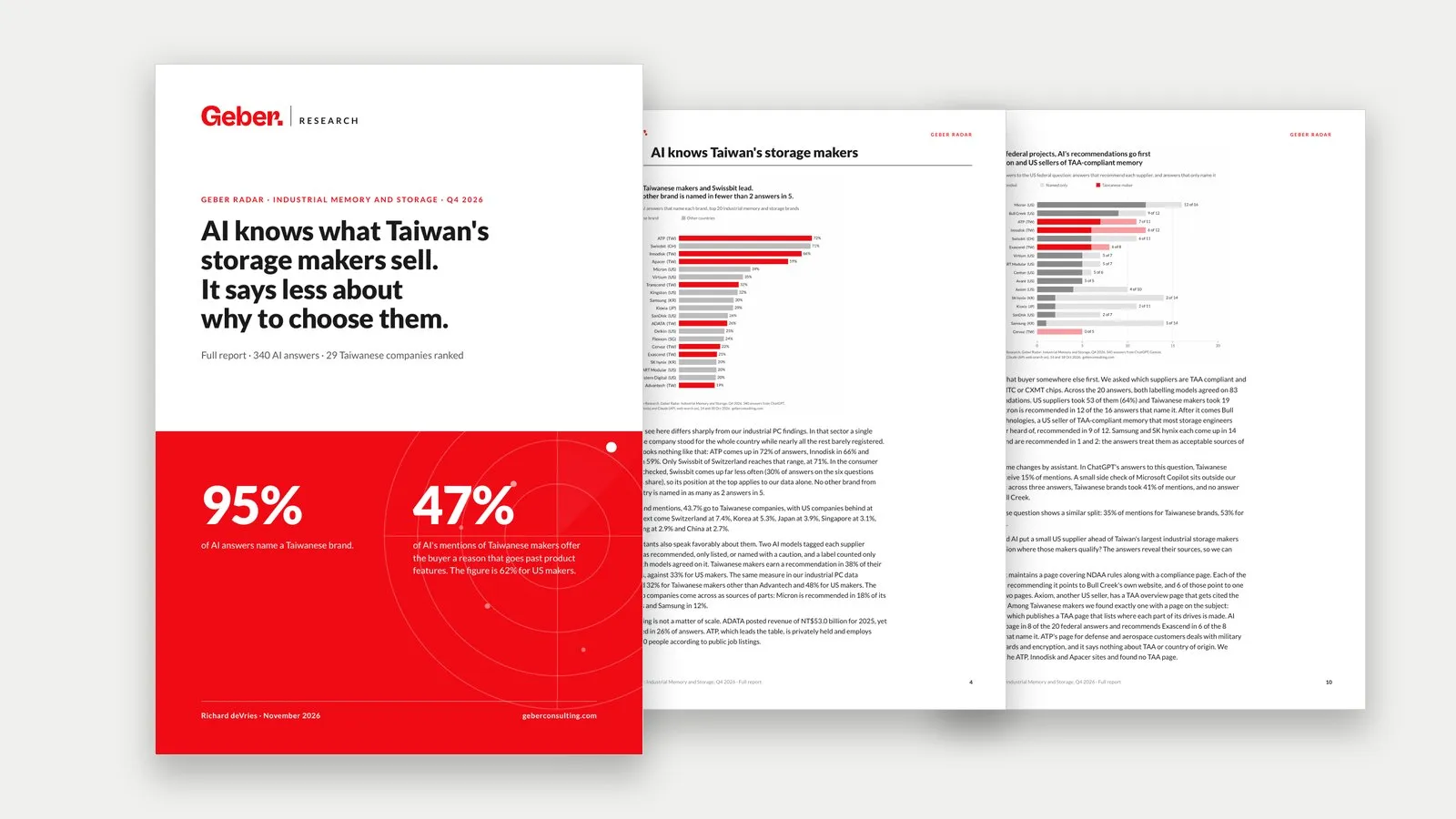
You can have the complete Geber Research report on industrial memory and storage at no cost. Fill in the form below and we will email it to you. Inside you will find:
- Your company’s row: where all 29 Taiwanese memory and storage companies we tracked rank, on each of the four assistants
- How AI describes each of the main makers, and what it ties each of their rivals to
- Which makers AI recommends once it names them, and which it only lists
- The questions Taiwan wins and the ones it loses, with the brands AI names for each
- The pages on makers’ own websites that AI cites
- The six steps in full, and where to start for a company at your place in the ranking
- Our calls for January, when we put the same questions again: which makers we expect to act, and how we expect AI to respond
The report is free, and the next step is free too. If you want to see how AI describes your own company and where it gets the facts wrong, ask us for a short company snapshot. There is no charge for either one.
How we did this
- Questions and assistants. We drafted 17 English questions of the sort an overseas buyer of industrial memory and storage might ask, such as “Who are the leading manufacturers of industrial-grade SSDs?” and “Samsung and Micron are phasing out DDR4. Which suppliers can still provide industrial DDR4 modules with a long-term supply commitment?” We ran each one through the APIs of ChatGPT, Gemini, Perplexity and Claude five times, with web search on, on 14 and 18 October 2026. That produced 340 answers.
- Counting. A brand counts once in an answer if its name appears anywhere in that answer. A brand’s share is the percentage of answers that name it.
- Recommended and described. Two AI models from different providers read every answer and labelled each supplier mention. We count a label only when both agree, and we checked 50 labels of each kind against the answers by hand.
- Limits. Answers shift from day to day. Overall shares are accurate to about 5 points either way. The federal and FIPS results each rest on 20 answers, and when we put both questions again in different words the picture held. We observed which pages the answers cite, and we ran no experiment on what causes a recommendation. A website search can’t prove that a page doesn’t exist; where we say a maker has no page on a subject, we mean we found none.
- Disclosure. Geber Consulting has worked with ATP Electronics, Cervoz and Winbond. They had no role in the questions, the counting or this article, and no company saw the results before publication. The full method is in the report.
About Geber Research
Geber Research is the research arm of Geber Consulting in Taipei. It takes on the questions that matter most to Taiwanese B2B companies, working from data we collect ourselves. Geber Radar, our first series, follows how AI assistants present Taiwanese manufacturers to overseas buyers, industry by industry, and runs every quarter so companies can see what shifts.
Independence. Every report comes with our questions and method published alongside it. No company may add or change a question, and clients see results only after publication. Before anything goes out, every figure is recounted from the raw answers.
Led by Richard deVries. Richard is a Canadian based in Taipei. He founded Geber and has spent more than 20 years on B2B branding for Taiwanese manufacturers. He studied at the University of Waterloo and holds an MBA from National Chengchi University.
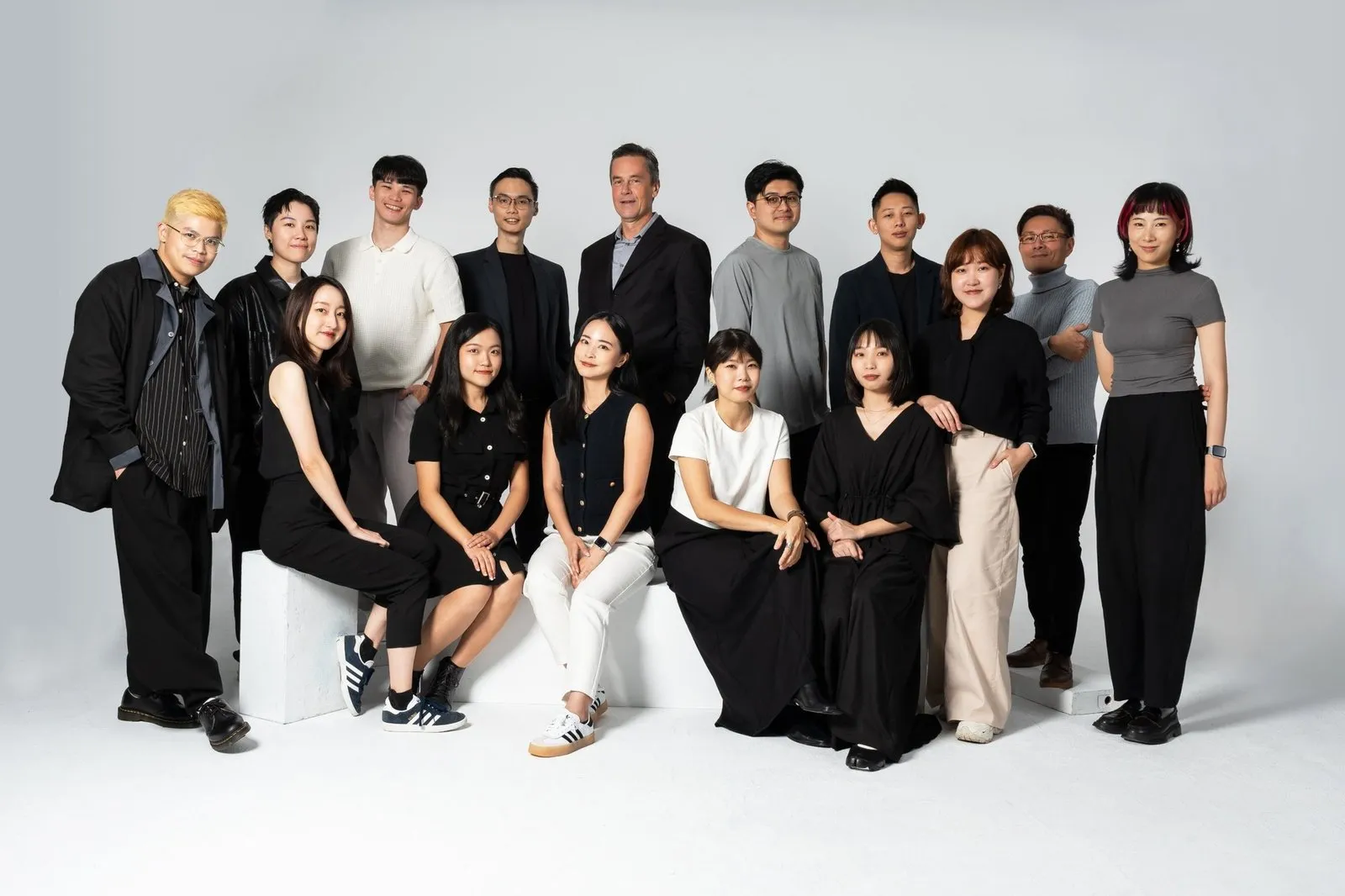
The team behind the work. Geber’s team covers brand strategy, corporate identity design, film and digital marketing, working for Taiwanese B2B manufacturers and international technology companies in Taiwan. Our case studies are at geberconsulting.com.
Further reading: Taiwan makes the world’s industrial PCs. AI knows one of them well.