“We’re a factory. Do we really need any of this?” We hear this question a lot inside Taiwan’s traditional factories. This article is for the owners and general managers of export manufacturers whose orders come through salespeople, personal networks, distributors and trade shows, companies with no marketing department or one or two people doing it part time. For companies like this, marketing is mostly a question of where to start and in what order. What follows is the sequence we use in our business-to-business (B2B) marketing work with Taiwanese manufacturers.
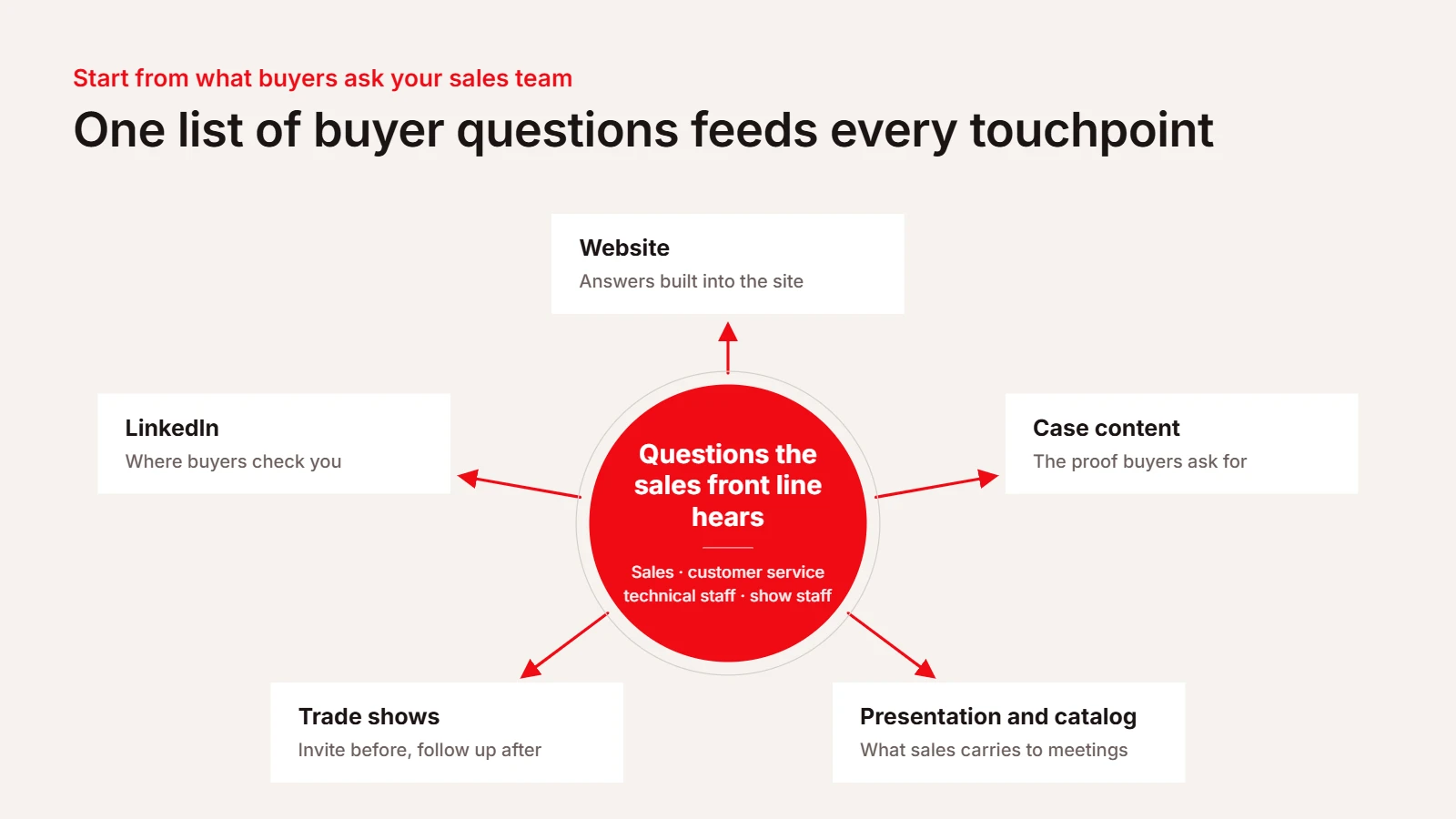
Manufacturing B2B marketing starts with the questions your sales team hears from buyers every day. Collect those questions, turn them into content, and get clear on the role your company plays in the supply chain. Build the few tools your sales team will actually use, such as the website, case studies and the company presentation. Once those are solid, widen out to LinkedIn and other channels, and carry the same materials into your booth.
Why a factory that sells through people needs marketing now
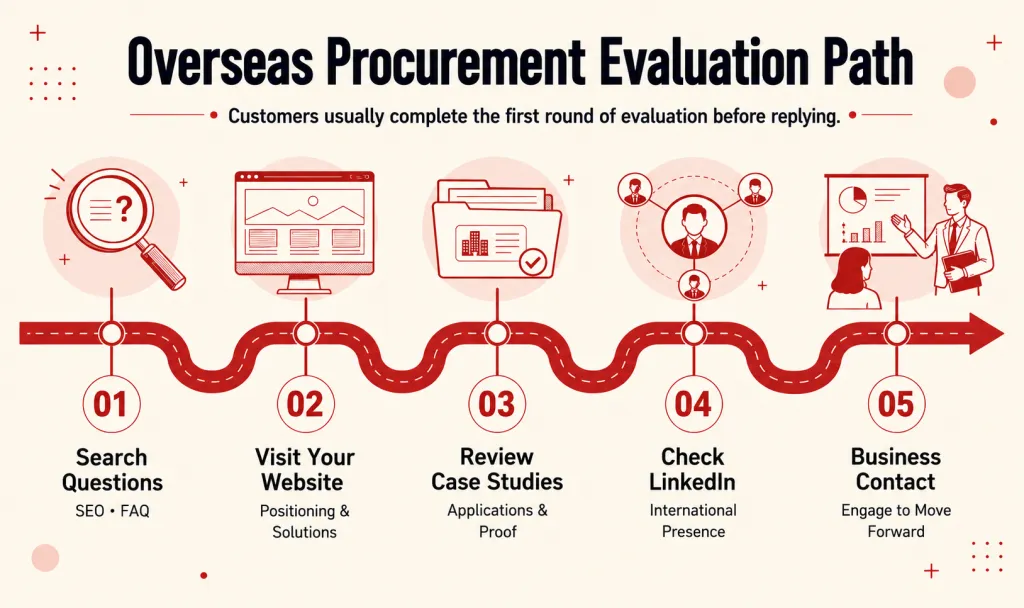
Orders used to start with a salesperson, a contact, a distributor or a trade show. Today’s buyer has done homework before they reply to an email, book a meeting or walk up to your booth. They search their question, look at your website, read your case content, check your LinkedIn, and only then contact sales. If nothing comes up during that check, many inquiries never happen, and you never find out what you missed.
Many owners in traditional manufacturing assume world-class quality brings customers on its own. We covered that in why world-class quality alone doesn’t win overseas buyers, and the short version is this: what a buyer can find before they ever contact you decides whether you get into the room at all.
Systech has been building Global Positioning System (GPS) trackers and fleet management software in Taiwan since 1987. Its revenue came mostly from overseas, sold through distributors and system integrators, and trade shows were where it met most of its new foreign buyers. When COVID-19 put a stop to the shows, that door closed, and there weren’t many others left for finding new buyers in North America and Europe.
In 2023 we ran the company’s first planned B2B lead generation campaign. We weighed telemarketing, email, online events, social media and exhibitions against each other and went with email. The audience was transport, logistics and IT service companies active in fleet management and telematics, beginning with the US market. We wrote a sequence of four emails around the brand story: an introduction, then the product solution, then a problem Systech had solved, and finally an invitation to start a project. They went out from a shared mailbox under a Systech salesperson’s name, and every answer landed with Systech’s overseas sales team.
Between 20 March and 20 May 2023, the campaign sent 7,523 emails to 3,291 contacts at fleet, logistics and technology companies, mostly in the US, with the rest spread across the UK, Canada and continental Europe. It logged 3,545 opens and 51 replies, and we handed Systech’s sales team 10 sales-qualified leads together with a priority list for follow-up. The case record ends with those 10 leads passed to sales, and it doesn’t show whether any of them became orders. The lesson of the episode is about channels. Leaning on trade shows to reach new buyers is a risk, and COVID-19 is when that risk showed.
Start from the sales front line: the question inventory
Where does marketing start? Our answer: with the people who face buyers every day. Sales, customer service, technical staff and the colleagues who work the booth hear the real questions, the objections and the proof buyers ask for. Sit down with them and the questions turn out to be concrete. How do you estimate lead times? Can you customize? How do we lower the risk of adopting your system? Do you have similar cases?
Collecting this is not a big project. Put the moments on the calendar: after every trade show, while memory is fresh, write down the questions heard at the booth; in the monthly sales meeting, spend fifteen minutes letting sales and customer service take turns on the new questions that came up. For each question, note who asked it (a prospect, a distributor, an existing customer), how often it has come up lately, and how sales answers it today. After a quarter, the repeats are obvious. Those are the topics worth turning into content, because buyers picked them themselves.
Sorting them is straightforward. Questions that can be answered in a few lines go into the frequently asked questions (FAQ). Questions that need a principle explained or options compared become website articles. When a buyer wants proof, that becomes case content. What sales uses at the table to persuade becomes presentation or catalog content. The inventory also needs one named owner, usually the head of sales, who reviews it every quarter and confirms that new questions are coming in and that sales is actually using what gets produced.
In the interviews we run for clients with their overseas distributors and buyers, the same requests keep surfacing. Distributors ask manufacturers for certifications, lists of approved customers (customers who have tested and adopted the maker’s products), success stories, tender documents they can download, stock on hand and regular meetings with the maker. Advertising almost never comes up. Buyers want evidence that shrinks their risk, and that evidence is content.
From the field (Richard deVries)
Chiher, founded in 1998 in Magong, Penghu, builds elevator control systems. In early 2020 we put written questions to its team about customers, competitors and products, and after a meeting on 3 February the team reviewed its answers with the owner that same evening before writing back. What came back: inside the elevator companies that buy Chiher’s systems, two people decide. Signing is often handled by a manager without an engineering background, whose priority is keeping the price down. The technician who understands the system has no say and is wary of learning a new one, worried that repairs will take longer. Chiher’s own Internet of Things (IoT) monitoring system had met the same reaction: early skepticism from the managers, technicians who didn’t want to learn it. Once managers had used the system, what they came to appreciate was the visibility it gave them into the time each site was taking and the moment faults were reported. The team also said the brand should stand for stability, with technical support and service behind it, and rejected “innovation,” because elevator people want as little change as possible. The final lines were 執著安全 卓越智控 in Chinese and Safer. Smarter. Chiher. in English, and 執著安全 (devoted to safety) came from the team’s own suggestions in the third slogan round.
The objections salespeople hear are content direction. They tell you who each page and each presentation really has to convince. In Chiher’s case, a signing manager who cares about cost, and a technician wary of a new system. The two need to hear different things, so the content has to be written for each.
Say what role you play in the supply chain
Many traditional manufacturers play several roles at once: maker of their own brand, contract manufacturer for other brands, distributor of foreign products. When the role is unclear, buyers can’t place you, and sometimes your own salespeople don’t know which card to hand over.
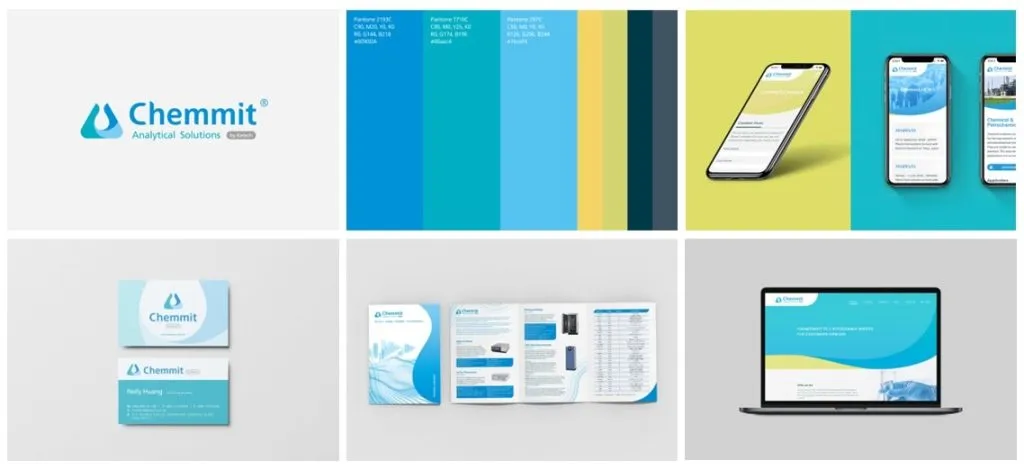
Chemmit is the classic case. Back in 2018, Ketech was getting ready to take Chemmit overseas, with Southeast Asia as the first stop, and its people weren’t sure whether to show up as Ketech the distributor or Chemmit the maker. Through a 2018 Branding Taiwan project we defined the brand architecture along with a rule for every meeting: outside Taiwan, always Chemmit. Inside Taiwan, the Ketech card when the customer had come for a distributed brand, the Chemmit card when the conversation was about Chemmit’s own products.
We also run into companies that build or distribute products for others and worry their own brand will read as a competitor to those customers and principals. Some keep two names apart on purpose. The worry is legitimate, and the answer depends on where the company sits in the supply chain. If you’re moving from contract manufacturing toward your own brand, see from OEM to own brand. If you’re moving from maker to solution provider, we covered that path in from maker to solution provider. And in why traditional manufacturing is falling behind, Richard writes about the bigger structural problem behind all of this.
What to build first, and what can wait
For a company with a small marketing team or none, order matters more than budget. For the overall strategy, see B2B marketing strategy from basic to beyond; here we only cover the sequence of the tools.
The website is the foundation. Many traditional manufacturers’ sites work like a product filing cabinet: the spec sheets are complete, but a buyer can’t find an answer to “can this company solve my problem.” A rebuild should put the questions you collected into the site structure, so buyers can find their own answers before they contact sales. Done well, the site itself starts bringing in inquiries.
Case content comes early, because it’s the material sales uses to prove itself. When clients can’t be named, the next section covers how to write cases anyway.
The company presentation and the catalog are what sales carries around. A good sales presentation answers the buyer’s questions in the order the buyer’s doubts come up, taking risk off the table page by page. The catalog follows the same logic: organized by application, a catalog lets a buyer find their own case faster.
Trade shows still matter. They amplify your content, as long as someone follows up before and after. We’ve seen the same ending too many times: a stack of business cards comes home from the show, gets typed into a spreadsheet, and becomes a list nobody follows up on. The full process for pre-show invitations and post-show follow-up is in B2B trade show marketing, before and after.
LinkedIn is one of the places overseas buyers look you up, and your sales development people can work it on a steady schedule. The approach is in our 2026 LinkedIn marketing strategy.
Chiher, from the field note above, shows what “build what sales will use” looks like in practice. It had never done a marketing project when it brought us in during January 2020. What it wanted was a brand the sales team could carry into meetings with elevator companies. By April that year it asked to shift part of the original scope over to sales tools for that team, and the contract was changed to match. What came out of it: 12 line icons covering elevator functions and states, from full-load detection through trapped passengers to maintenance, plus a 24-page product catalog and an 8-page brochure. We designed the website as well, in Chinese, English and Japanese. As of 2026 that same 2020 design is still running, now in six languages, the CHIHER logo on every page and Safer. Smarter. leading off the English home page. For most traditional manufacturers, our advice is to get the sales tools done early.

From the field (Richard deVries)
A major international show was coming, and we produced a medical equipment maker’s booth design, brochure, product catalog and business cards in a hurry. The date was fixed and the runway was short. The client’s sales supervisor told us as much before the show, and he asked to go over the designs afterward and plan the next phase of marketing. Once the show was behind us, the client’s first request was the brand strategy and the style guideline, ahead of any further materials, and the summary of the review meeting, agreed by both sides, locked in that order. One more thing came out of that review: the stand graphics would get a proper upgrade, then stay the same from exhibition to exhibition, so visitors would come to know the stand on sight. In hindsight the sequence should have run the other way: decide what the market should hear, then make the materials. A fixed show date shouldn’t be the one setting the order.
Writing cases when clients won’t be named
The most common obstacle to case content in manufacturing is a client who won’t allow their name to be published. That’s normal, and the case can still be written. Describe the industry, the application, the problem, the approach and a result you can share. The client’s name never appears, and the case still works.
Take Chiher once more as the worked example. On 10 January 2020 a power cut took out the whole of Magong. Chiher’s IoT elevator monitoring system caught the outage instantly, flagged which elevators were hit and where passengers were stuck, and Chiher’s people were already on the road before a single customer phoned in. The story reached us in Chiher’s written answers five days later.
Run it against the checklist. Industry: elevator service in Penghu. Application: real-time monitoring. Problem: a citywide outage with people trapped. Approach: the system immediately flagging the affected elevators. Result: staff already moving before any call came in. No customer and no building gets named, yet the system’s value comes through. That is what a result you can share looks like.
Frequently asked questions
We have no marketing department. Who does the work?
A head of sales plus one part-time coordinator is enough to start. Sales and customer service supply the question inventory; the organizing and writing can be outsourced or given to one named person. Marketing in traditional manufacturing often starts as half a person. What matters is that someone owns the progress, so things move.
Should we build the website first or start on social media?
The website first. Everything a buyer checks before contacting you lands on the site eventually. However good the social media is, if it sends buyers to a product filing cabinet, the inquiry doesn’t happen. Once the site answers buyers’ questions, social media and LinkedIn have somewhere to send people.
Our clients won’t let us publish their names. How do we write cases?
Write them the way the previous section describes: the industry, the application, the problem, the approach and a result you can share, with the client’s name left out. Cases like this still persuade, because buyers want evidence, and the detail is what carries it.
What should we look at in the first year?
Look at what can be traced: replies, meetings booked, qualified leads passed to sales. The Systech email campaign above was measured exactly this way. Whether those leads became orders, or whether brand awareness moved, often can’t be traced in year one, so say so plainly. Count what can be counted, and next year’s budget has a basis.
Next steps
Companies that follow the order find marketing gets easier over time, because every tool connects to something sales actually needs. If you want help setting the sequence for your company, talk to us. Our B2B digital and trade show marketing service page describes what we do in practice.